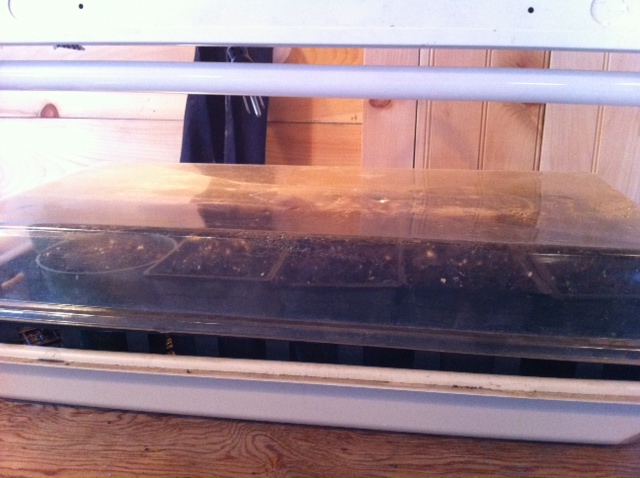
The seeds are all planted in six-cell flats or small plastic pots, and then placed in perforated trays for easy watering. They are also heated from underneath by heating trays and covered by plastic tops so they will stay warm even though it’s still cold around here.
Category: garden
-
It’s March!
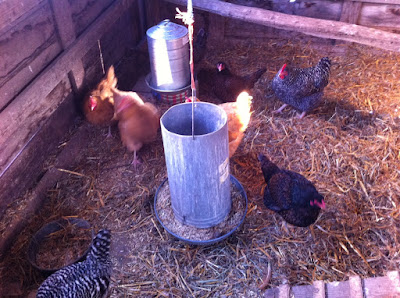
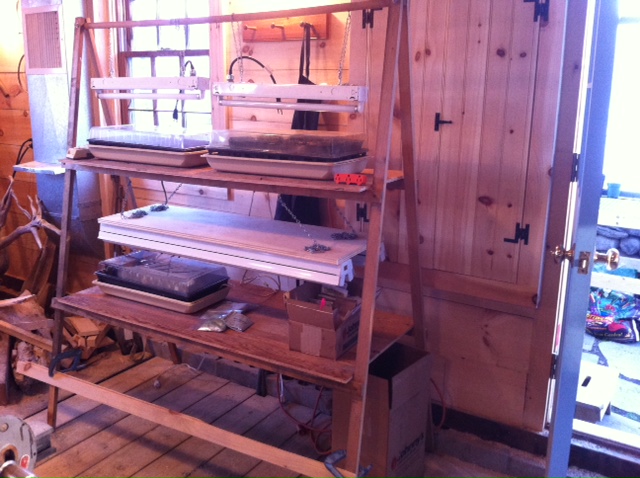
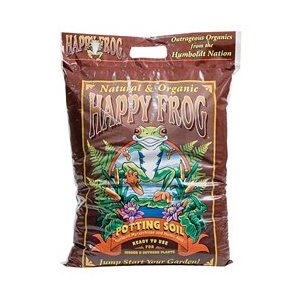
So, good news! Broody chicken rehab in the rabbit hutches worked! I released the two hens back into the coop last Monday morning and they’ve been acting pretty normal ever since. Here they are, acting pretty normal.More good news! We planted our first seeds of Spring today!! My mom and I set up a little grow light A‑frame in Dave’s wood shop, which is right next to the greenhouse.As you can see, there’s not very much going on yet, but it’s exciting! Today, we planted flowers (asters, calendula and sweet peas) as well as cilantro and parsley. These are the plants that require the most germination and indoor growing time before being transplanted outside. It’s still pretty early for us to be starting most seedlings, especially since we’re not sure when things are going to be able to go into the ground outside yet, but next week it’s going to be time to start the leeks and by the beginning of April things will really be getting going. And thanks to a lot of rain, the crusty, dirty snow piles are starting to recede, so it really does feel like Spring might actually be coming…Until then, however, here’s some more pictures of the greenhouse:The lettuce, swiss chard and kale is all doing great, and we’ve set up a little workstation with dirt (the mix we used today was half Happy Frog Potting Soil and half peat moss) and an area for planting. -
Planning for Vegetables and Pictures of Chickens
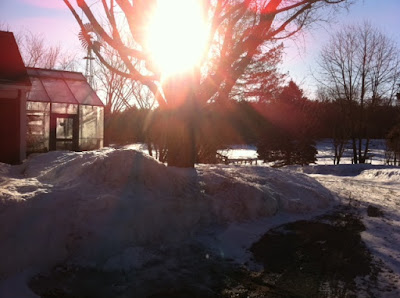
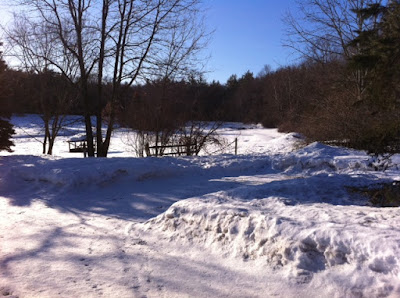
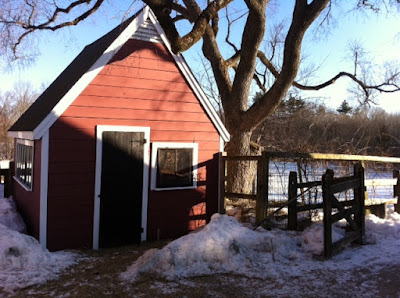
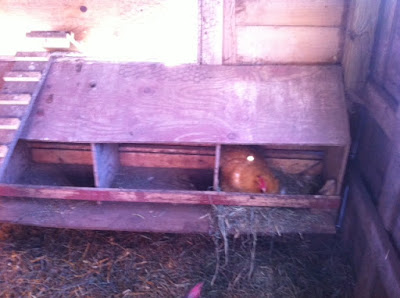
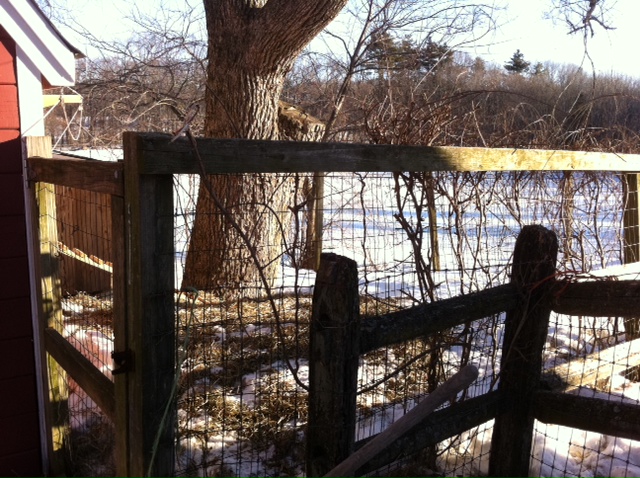
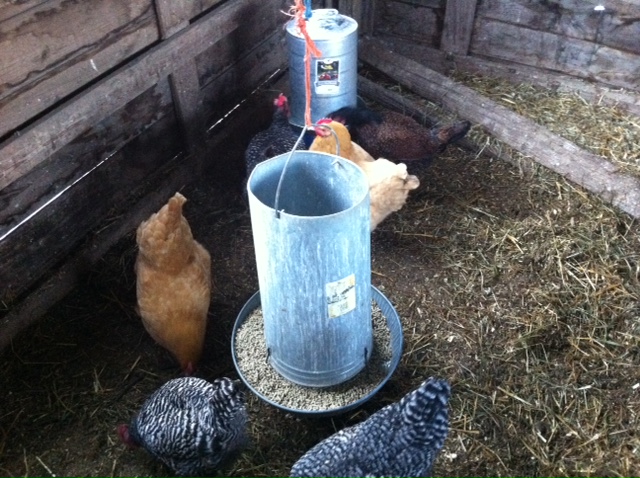
The seeds are arriving and slowly piling up in the corner of my room. Meanwhile, I’ve been trying to figure out what to do with them. In order to organize the information about each plant and get ready to make a full planting schedule I’ve been putting together spreadsheets. I have a page for each vegetable and then I list all the varieties separately. Then, using the Johnny’s catalog, the Cornell Cooperative Extension website and Coleman’s The New Organic Grower, as well as a couple of other sources, I’ve been compiling important growing information.First of all, I have to figure out what vegetables I’m going to start inside and then transplant, and what vegetables I’m going to seed directly into the garden. Some vegetable plants really have to be started inside, like the brassicas (cauliflower, broccoli, brussel sprouts and cabbage) and nightshades (tomatoes, eggplants, peppers). Luckily, the woman who owned Dave’s parents house before them had a cut flower business, and so she built a small greenhouse off the garage.The greenhouse, the windmill and the sun this morning The greenhouse really warms up during the day. Even in the middle of the winter I often have to open a window to stop the temperature inside from skyrocketing past 90 degrees F So far I’ve just been growing lettuce, kale, swiss chard and bak choy in the greenhouse. Dave built me some tables and boxes, about 6″ deep and of various sizes, and I was able to grow a fair amount of small, yet delicious, greens over the winter. This week however, I’m going to be pulling all the soil and the boxes out of there so we can start fresh with our new potting soil and transplants for the Spring.Next, I have to determine whether or not I’m going to be succession seeding the vegetables and, if so, how many times. For example, I’m growing 100′ (one row) of a variety of carrots called Scarlet Nantes. These carrots will grow from May 1st to July 15th, which is about 12 weeks. During those 12 weeks I’m going to want to be planting new seeds directly into the garden (carrots are difficult to transplant on account of their roots becoming irregular, plus they grow pretty quickly) every 3 weeks to ensure that I have a consistent supply of new growth. This means that I’m going to be doing at least 4 plantings, and so therefore each planting will involve seeding 25′ of the garden.This is all getting boring so I’ll just show an example.Each vegetable has it’s own sheet. After I’m done with the sheets I’m going to lay it all out on a MASTER calendar so I know exactly when I’m going to be planting everything, and how. Pretty exciting, right?Meanwhile, there are a lot of other things to think about. Right now, I’m worried because we keep hearing more and more about how wet the land we’re planning on planting on is. We haven’t really looked at it critically without the snow and so we’re not sure what to expect. The moisture could be an issue because we have to wait for the area to dry off in the Spring before we can even till the land, and with all the snow outside right now it doesn’t seem like it’s ever going to be dry. All this probably means that we’re going to get a late start this year, and are going to have to rely heavily on transplants.Right past those trees and under all that snow is the site of our future vegetable garden Alright, enough about the garden. Here’s some pictures of chickens!This is the chicken coop for layers Their yard. I put down some hay so they can come out and walk around on the snow which they seem to love until they get too cold And here they are! Laying boxes Right now we have 9 laying hens and we’re planning on bumping up the number to 30 this Spring, which is about as many as we can fit in this chicken coop while still making sure they all have enough space. That’s going to involve building a couple more laying boxes, although right now they all insist on using the box all the way to the right, and have kicked all the hay out of the other two.The hen in the laying box in this picture appears to have gone broody in the last couple of days, which means that she’s become intent on sitting on her eggs day in and day out, even if it means that she doesn’t eat or drink. This is also a problem because our delicious eggs are going bad underneath her. I’ve been reading about several ways to cure broodiness, everything from dipping their stomach in cold water (I don’t think that’s a good idea in the middle of Winter) to putting them in a cage by themselves up off the ground and away from the nest. I’ll report back later on how this problem progresses and how we manage to solve it. If anyone has any ideas, let me know. -
More Detailed Vegetable Garden Plans…Hooray!
Now, I’m sure that the pigs and our new flocks of chickens are going to present plenty of problems in the near future, but right now the biggest challenge for me is designing the half acre vegetable garden. In this post I’m going to describe my plan for the garden, as well as the thought process behind it. As I said before, my mom (Hasso) is really collaborating closely with me, especially when it comes to making decisions about the garden, so when I say “my plan” what I really mean is “our plan”. Together, over the last couple of weeks, we’ve been trying to gather as much information as possible from farmers and experienced gardeners in the area. Luckily, everyone we’ve talked to has been unbelievably helpful. We also attended a NOFA (Northeast Organic Farming Association: MA Chapter) seminar on Systematizing a Diverse Vegetable Operation, which also provided a lot of great information (a lot of which went right over my head).
In addition, we’ve both been reading Eliot Coleman’s book, The New Organic Grower which has been pretty indispensable. Eliot Coleman, who has a farm in Brooksville, Maine, is one of the kings of small-scale organic farming and his book has been a great entry level textbook for us.
However, one of the lessons I’ve learned pretty quickly is that no one is going to tell you exactly how to farm vegetables, instead you’re just going to end up with a bunch of suggestions. It seems as though growing is such a personal thing, that instead of depending wholly on one text, or one afternoon of advice, it’s important to pick and choose what makes sense to you. Each piece of land is different, and each style of growing is different, and farming is about developing a close enough relationship with your land to understand what it needs to be successful, and what you need to be successful along with it. Over the last couple of weeks I’ve heard several times that “farming is as much an art as it is a science”. I’m a sucker for phrases like that. I can already tell that I’m going to be repeating that phrase to people for the rest of my life.
So, back to my (our) garden.
The first step was to take a soil text to determine what our soil’s like. We dug down through the snow and pick-axed some earth from the frozen ground to send into the lab. We’re still waiting for the results, so I’ll post more information later.
Next, I got a map of the property and we laid out exactly where we thought the garden should be (see previous post). It was important to keep the plot about 15′ out from underneath the tree-line, to make sure the plants will have enough sun, and to keep the rows away from Black Brook, which runs between the vegetable garden and the horse ring seasonally. Ideally, the area would be flat, however, our garden has a slight slope to the East. Luckily, it’s slight enough so that apparently it’s not going to be a big deal.
We were ready to plan the plot. Coleman recommends dividing your land into 5′ rows that are each 100′ long, and then planting 4′ and leaving 1′ for a path. We were advised by many people that 4′ was a little too wide of a planting row for us and that 1′ was a little bit narrow of a path. Since we’re planning on doing the planting, weeding and harvesting by hand, it’s important that we can easily move up and down and around in the paths and reach into the center of the rows. Therefore, we decided to make 3′ rows and 2′ paths.
We also learned that it was very helpful to be able to drive a truck right into the middle of the garden. This option will help us to bring supplies into the center of our vegetable patch, and move harvested produce easily and effectively out. With these stipulations in mind we made the following plan:
I had to decide how to fill up all these rows. Enter: seed catalogs. Seed catalogs are so much fun; they are also so overwhelming (someday ask me about my bittersweet one-week love-affair with seed catalogs). I got most of my seeds from High Mowing Organic Seeds, because they’re local (out of Vermont), but I also got a fair amount from Johnny’s Seeds, which has everything, and Seed Savers Exchange, which sells primarily heirlooms. I went through vegetable by vegetable and used information from the catalogs as well as information from Coleman’s book and off the web to figure out what varieties I wanted to grow, approximately how much of each vegetable I wanted, how many plants I needed, how many rows of each vegetable I wanted to plant, and, therefore, how many seeds I needed. Then I placed the order. This all took me about a week, and still it felt like mostly guess-work.
This year I’m going to attempt to grow: beans, beets, brussel sprouts, cauliflower, cabbage, carrots, celery, chard, corn, cucumber, eggplant, fennel, all kinds of greens, kale, leeks, peas, peppers, parsnips, radishes, squashes, tomatoes, herbs and flowers. I got a bunch of different varieties of each vegetable, so I can really find out what I like and what works best in our climate and soil.
Now I’m in the process of deciding what goes where, and attempting to lay out a planting schedule. I have to determine when each seed needs to be planted, and whether it will be planted inside and then transplanted into the garden or seeded directly into the ground. A lot of the vegetables need to be succession planted as well, that is to say that I will need to be planting them throughout the season to guarantee a constant and consistent harvest (aka lettuce, beets, carrots etc). All of this needs to be carefully and clearly planned and organized as well. So far being a farmer means making a lot of charts.
Things to figure out:
Tilling schedule: when the ground unfreezes we’ll need to till the plot before we can plant it. This is complicated and involves a lot of machines and tractors and knowledge. There is also a school that argues that tilling is not necessary. More on this later.
Fencing: we need to figure out how to keep all the rodents, woodchucks and deer out. This is also difficult, and involves deep thought, spending money and possibly various fence erecting equipment. I’ve been warned that deer can eat your entire crop of heritage french filet beans in one night. Chilling.
Cover crops: once we figure out what’s wrong with our soil we can determine what kind of none-edible cover crops we should plant in areas that are fallow (aka. unplanted) in order to add nutrients and enrich.
…and much, much more.
I hope all this is interesting to you guys. If you have any questions let me know!