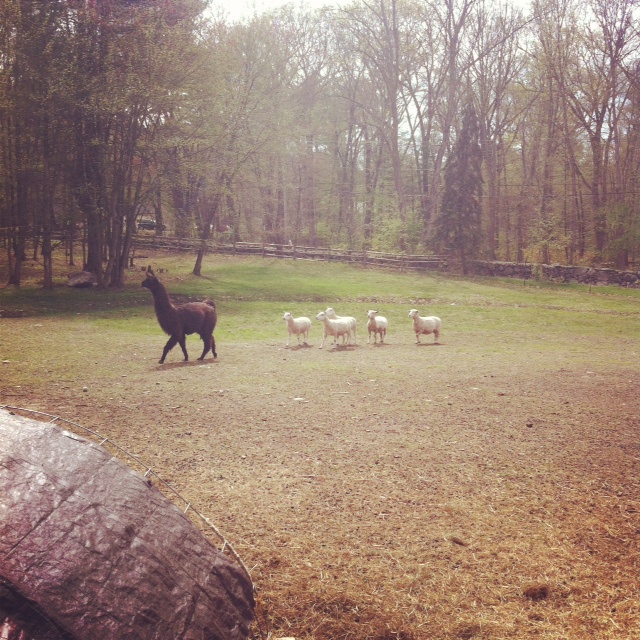
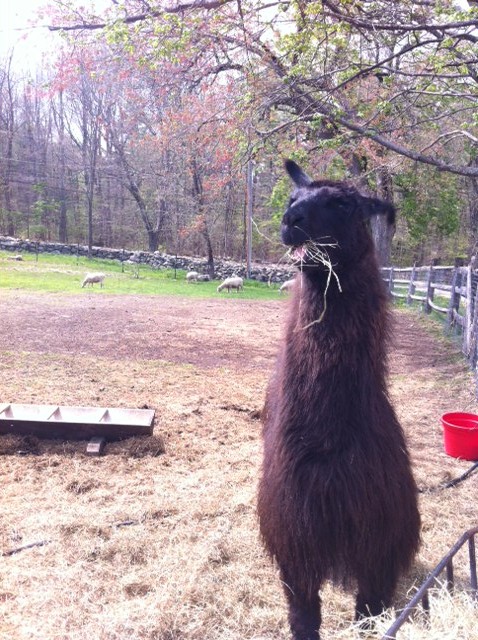
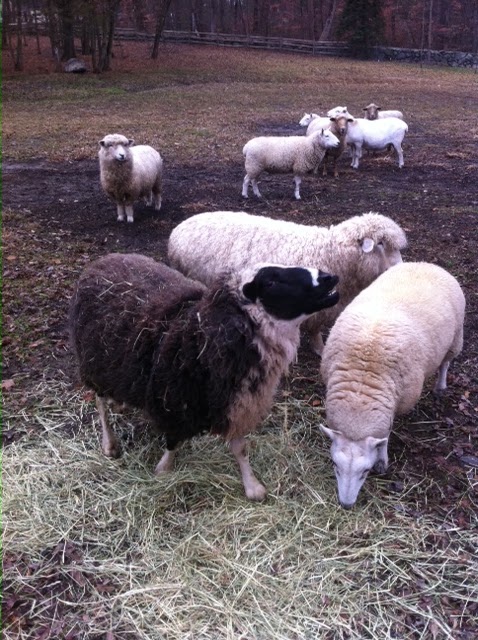
It’s a boy! He was born early this morning, and seems very healthy and strong. When we came out to the pasture this morning, Bridgette (and Diamond) were hovering over the lamb nuzzling it. Here are some pictures that Dave took this morning (click on the thumbnails to see the full size images).
First of all, I hope that you’re all enjoying our new site. Aside from having a sleek new banner, some new pages and a better URL address, our website also makes it possible to reserve meat online using Paypal. Just got to ourPre-Buy Meat Onlinepage.
I’ve been meaning to post for a very long time, but so much has been happening around here that I didn’t really know where to start. However, yesterday there was a big enough change that I couldn’t help but come online and share it with all of you…
Meet Diamond!
Meet Diamond, our new llama from Pelham, NH. Dave and I just went to pick him up yesterday, and so far he’s exceeded our expectations for awesomeness.
I’m getting ahead of myself though. This all started because we’ve been looking into finding some other pastures for our sheep to graze on this summer. Because we bred all our ewes to a Finn ram, a breed that’s known to throw triplets, quadruplets or even quintuplets, I’ve been getting a little nervous that we were going to end up with more sheep than we have pasture for at Black Brook Farm. Add to this worry the fact that we’ve been getting very little rain so far this year, and we have to ready ourselves for the possibility of a very dry summer, and you can see why we might want some back up fields. However, the more we talked to people, the more obvious it became that there was no way that we could put our sheep out on pasture somewhere without protection against coyotes. Dave and I have yet to see a coyote since we moved to BBF (which could be because of all the barking dogs, or the horses, or just blind luck) but there are surely coyotes in these woods too — so that’s where Diamond comes in! We researched some different ways to protect our girls and their babies from predators — guard dogs, permanent structures — but a llama seemed like the best solution. Diamond eats the same things that sheep do (unlike a dog), he doesn’t require any special training, and he’ll stay behind 4′ electronet fencing! Plus, he’s a perfect gentleman, and apparently has never spit at a human, he just doesn’t like coyotes. There’s lots of information about guard llamas online, but here’s a nice succinct study if you want to read more: http://www.sprucelane.com/guardllamas.pdf.
The ewes checking Diamond outSo handsome!
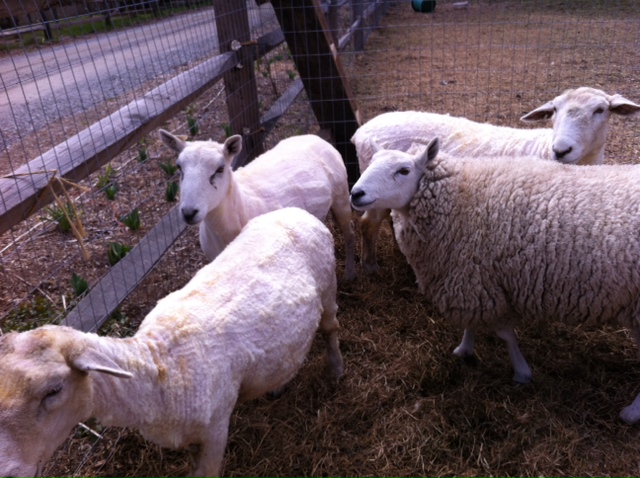
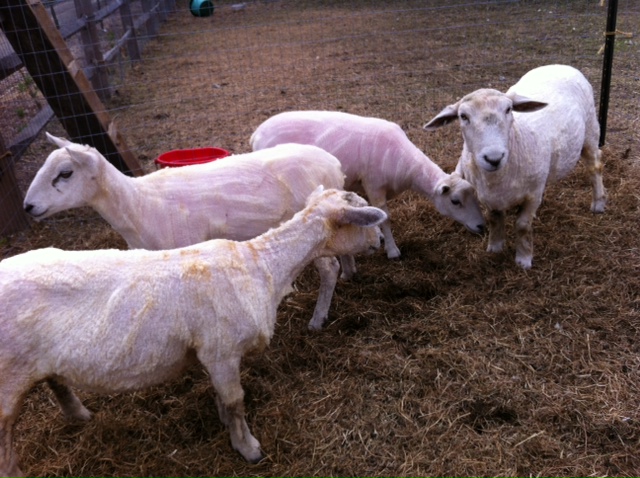
The sheep also have gotten sheared and look more pregnant than ever! We’ve expecting lambs to drop any day now.
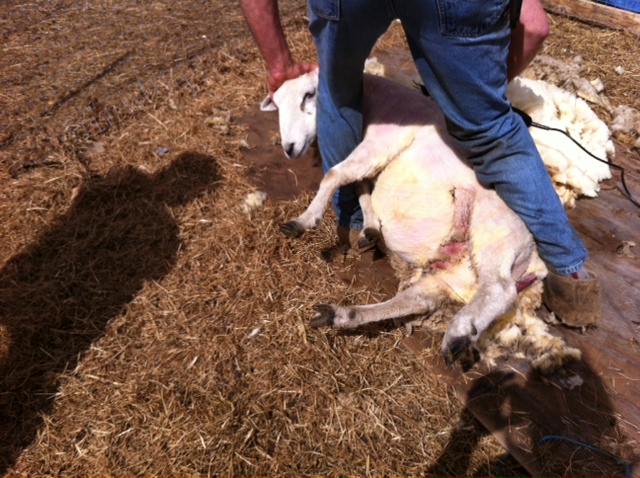
BeforeDuring…
After
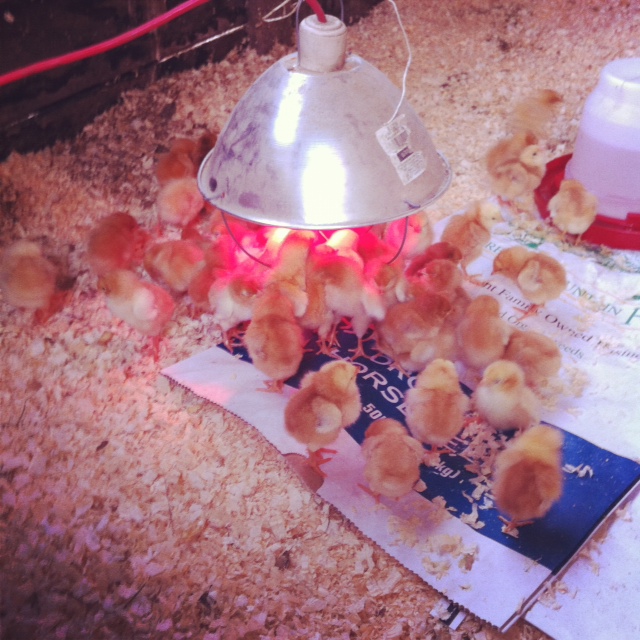
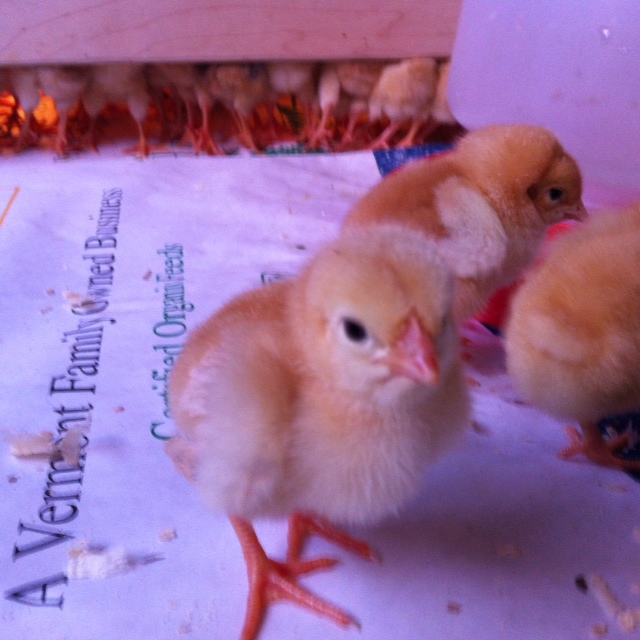
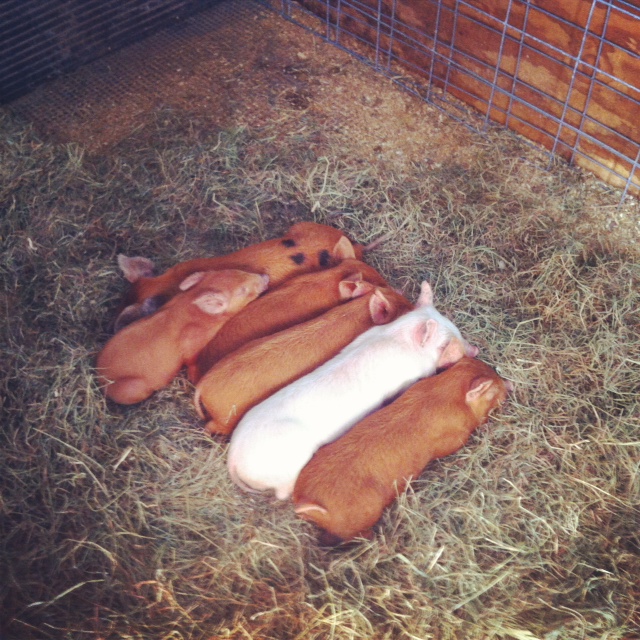
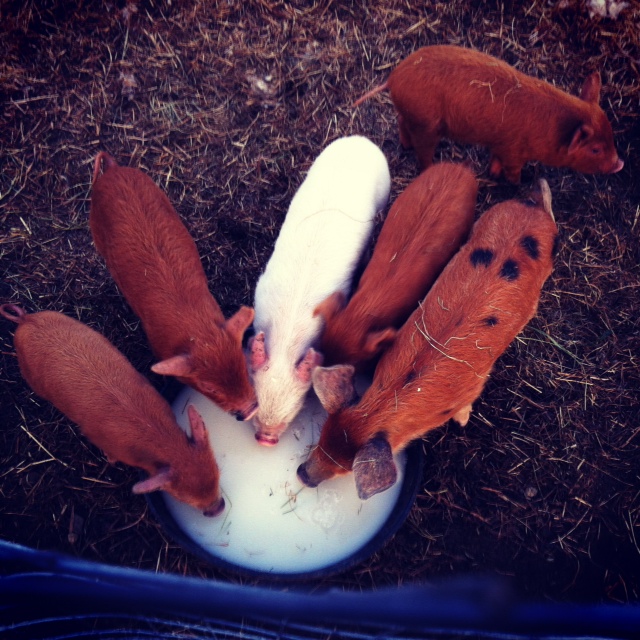
And now, finally, our new baby chicks and piglets…We were on our way up to get our breed sow from Vermont when we got a call that she had had a miscarriage, so we decided to go with piglets instead. It’s sad that we’re not going to get a big beautiful pig momma, and that we didn’t get to see our piglets birthed, but it’s nice to have control over exactly how many piglets we have (six right now!) I’m just going to post some pictures, and I’ll write more later. It’s almost 9 AM and there are things to do today so I have to wrap this up.
Baby chicks under the heat lamp
More baby chicks (note all those feet under the heat box)
Coming home in the trailer
Chowing down on whey
And finally, the picture you’ve all been waiting for…
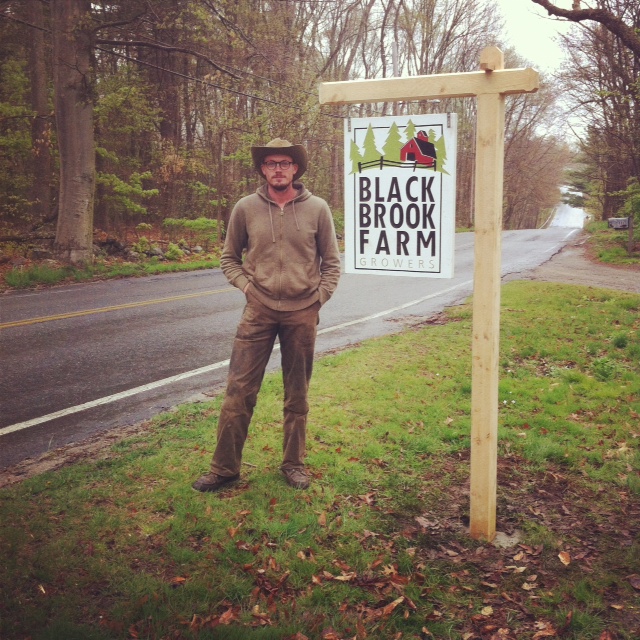
Black Brook Farm Growers 2012 CSA has been filled! We’re all getting really excited for this year, and we’ve all got a lot to do to get ready. Our seeds have all arrived and we’re going to start planting this week. My mom has been bravely tackling a fresh set of spreadsheets (in order to set up our planting and harvesting schedules), Dave and I are working on a new website that we’re hoping launching this year and we’re talking about cleaning out a section of the barn for our new CSA pick up spot.
The sheep are all doing well and are (hopefully) pregnant. We started trimming their feet this week, which requires catching them and flipping them, not the easiest feat, especially when they’re as large as this one:
Laurel: the sweetest sheep in the world
Carlisle Grows Green the new Carlisle School gardening and composting program has been nice enough to give us their compost. Yesterday Dave and I shoveled it into the hoop house, where the warmth will hopefully speed up it’s progress.
That’s all for now! Pictures of our first little seedlings coming soon
We had a great holiday season here at Black Brook Farm. By Thanksgiving the farm was pretty much shut down for the winter, and we were all able to take a break and spend time with our family and friends. We read, worked on projects that had been pushed to the side, watched the movies we’d been wanting to watch, ate a lot of amazing meals and even slept in!
Black Brook Farm Growers holiday ham getting ready to be brined
The one thing we did not do was blog, as I’m sure all of you loyal fans have noticed, but now that it’s the new year and all the Christmas candy is gone, we’re gathering up seed catalogs and getting back to work.
Up until now, every month has been a new adventure, with new excitements, challenges and surprises. But we’ve finally come full circle and are back in the winter planning stage (just like when this blog was born a year ago). This year has taught us a lot, and we have a much clearer picture of what we want Black Brook Farm Growers to be.
Here are some of my new years resolutions for Black Brook Farm Growers:
Get organized: I’ve said it before and I’ll say it again, farming requires A LOT of organization. That means tons of spreadsheets, lists and records so that you can remember EXACTLY what worked and what didn’t. Every farm is different, so as helpful as books and other farmers can be, at the end of the day it’s important to learn from your own land. Organization is not always my strong point, but this year that’s going to change. There’s some great online software out there for small organic farms, this year I’m going to try using AgSquared, which I learned about in a workshop at last years summer NOFA conference.
Take risks: We want to keep stretching ourselves and learning new things. That means experimenting and being creative, and not being afraid to try something that we think might work. There’s a lot of room for creativity in farming, which is one of the reasons I love it so much.
Make money: I know it’s not classy to talk about money, but BBFg is a business, and it’s important for Dave and I to prove that we can make a profit doing this work. Being able to create a financially viable business not only means that we can continue farming, it also means that we can show other would-be farmers that this is a dream worth pursuing. This last year we saw, and were inspired by, a lot of awesome small farms that were financially stable. We’re confident that it can be done, but that doesn’t mean that it’s easy.
Efficiency: We need to use our time and resources as effectively as possible to minimize waste on the farm. (This is Dave’s resolution and it ties in nicely with getting organized and making money).
Create a community around the farm: This year, as you may or may not know, we’ve decided to focus entirely on CSA, or Community Supported Agriculture. That means that instead of going to farmer’s markets, or having a farm stand, we are going to have a limited amount of members that buy into the farm at the beginning of the season, and receive a weekly stipend of vegetables as a result. Not only is CSA a great way for to help meet all of the resolutions I’ve already listed above, it also means that we’ll have a community of people who are interested in local food coming to the farm every week. We’re excited to share the farm with our members, and to use the farm as a space for community events. We’d also like to have workshops at the farm to teach our members, and the larger community, about cooking, butchering, preserving and more.
These are just a few of my resolutions. I’m sure over the next couple of weeks, as we begin planning, there will be many more.
Before I say good-bye (and get back to all that work I’ve been talking about), I’d like to mention one exciting December development, our ewes have been bred! Eli, a Finn ram, came and stayed at Black Brook and spent some quality time with our sheep. He just went back to Belmont and we miss him already. He’s a great looking ram, and was very sweet with the girls. We are crossing our fingers that the ewes are all pregnant. They should lamb sometime in late April or early May.
Eli. We’re hoping some of our lambs will have his coloring.
When Dave and I got the message that a woman in Bedford was looking to sell five of her sheep my first thought was, absolutely not. After all, prudence tells me that we should grow slowly, and so do the majority of organic farming how-to books.
“But isn’t part of the fun getting in over our heads a little?” Dave asked.
True, there are organic farming how-to books that would agree. The Dirty Life,for example (a great read). Well, maybe, I thought. So we did some research, went and visited them, spent hours writing pro and con lists, and decided that it was too late, we had already fallen in love.
Can you blame us?
Laurel, the most friendly
Plus, we justified, lamb will make our meat CSA that much more desirable next year (if you’re interested, subscribe to our mailing list on the right). And I’m pretty excited about their wool as well.
Luckily for us, sheep are pretty easy to take care of. They eat primarily grass, are very hardy, and are extremely sweet. We’re committed to raising them organically, without any vaccines or antibiotics, so that means that the only tricky part is we’re going to have to intensely rotationally graze them. That means they’ll have to be moved almost daily (and definitely daily next spring when we have lambs that are much more susceptible to parasites). Moving them everyday means that they will more fully graze the pasture. As one sheep owner explained, “if you give them too much space to graze, they’ll eat all the cake and none of the vegetables”. It also means that they won’t be grazing over a build up of their own excrement, therefore reducing the chances of them getting parasitic diseases.
Again, we turned to Wellscroft Fence Systems in New Hampshire, and they hooked us up with some lightweight electric sheep fencing and a lot of great advice. For now, we’re grazing them on the back pasture, with plans to install some permanent fencing and bring them up closer to the house this winter.
Grazing
A Cheviot
Phlox (Romney), on the left. Laurel (Romney) in the foreground. Bonnie, Blair and Bridget (the three Cheviots) next to Phlox.
They love the moveable shelter Dave built them.
We purchases five ewes, two Romneys and three Cheviots. We’ll breed them this fall and hopefully they’ll all twin in the spring, providing us with lamb for market by October. Both are considered good breeds for meat and fleece. The Romneys are known as good sheep for beginners, very easy going, while the Cheviots are considered a little more wild. Cheviots are said to have been roaming the hills between Scotland and England as early as the 14th Century (wikipedia) and are “noted for hardiness, longevity, productiveness, milking, and mothering ability and for their great activity” (American Cheviot Sheep Society). Because they are “hill sheep” and were often left to their own devises, they are more skittish and wary of predators than the more trusting Romneys. We figured it would be worthwhile to try out a couple different breeds.
So you can all look forward to more sheep stories this winter.