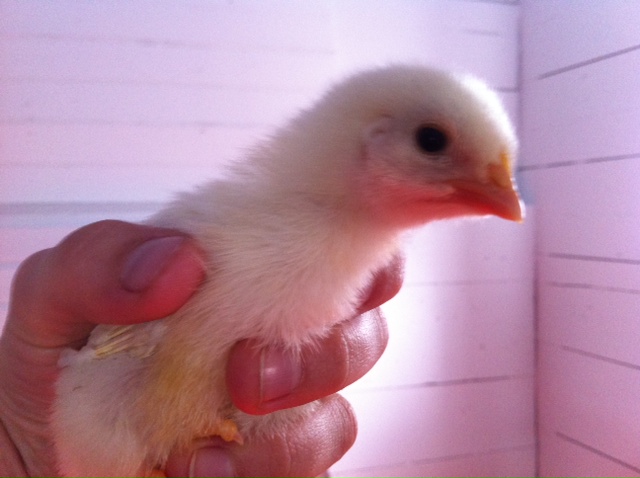
Cornish X Rocks born April 16, 2011
Author: Gallagher
-
New Meat Bird Chicks!!!
This little guy has a bum leg so we’ve put him in his own apartment so he’ll be safe from all the other chicks running over him and pecking at him, and so he doesn’t have to compete for water or food.We decided to give him a wall of carpenter clothe, however, so he could still see everyone and wouldn’t be too lonely. He seems to been eating and drinking water, and we’re hoping that with time his leg will get stronger. -
Our First Farmer’s Market
We’ll be selling our fresh eggs at the last Winter Carlisle farmer’s market this Saturday, April 16th!
-
Welcome Back Wilbur!
Where to begin…?
Although we haven’t quite eked past the last projected frost date (around May 1st in Eastern MA), it feels like it’s officially Spring. There’s green grass, buds coming out on the trees, Kimball’s farm ice cream stand is open for the season, and Wilbur, the Vietnamese pot-belly pig (not for eating, although he does sound like he would be delicious in a spring roll) has emerged from his den in the back of the barn and I can see him grazing in the fields from my window — which is open by the way. I seem to have gotten in the habit of always starting my posts with a comment on the weather, but it’s pretty much all we’ve been thinking about around here. When’s it going to be dry enough to till the field? Is it warm enough to open up the greenhouse? Is it still too cold for us to buy meat bird chicks and put them out to pasture? Every decision we make requires input from Mother Nature.
Biodynamic Sowing and Planting Calendar
There are some that argue that when taking cues from our environment we should be paying attention to more than just the local weather report. I’ve been reading a little bit about biodynamic agriculture, which is an organic method of farming that emphasizes how interdependent the plants, animals and soil on a farm are. Like many forms of organic agriculture, biodynamic farming is about creating farms that are closed loops. This balance is made possible through the integration of crops and livestock, the recycling of nutrients, and the maintenance of soil — no outside assistance or pesticides necessary.
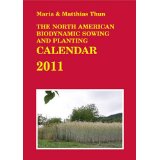
In addition, biodynamic farming also considers that there are astrological impacts on agriculture. Most of these impacts are exerted by the moon as it passes through the twelve constellations of the zodiac. Maria Thun (and now her son Matthias) are the authorities on biodynamic astrology, and have been releasing their Biodynamic Sowing and Planting Calendar every year for almost a half a century. In her most recent calendar she writes:
“In its 27-day orbit round the Earth the Moon passes through the constellations of the zodiac and transmits forces to the Earth which affect the four elements: earth, light (air) water and warmth (fire). They in turn affect the four parts of the plant: the roots, the flower, the leaves and the fruit or seeds. The health and growth of the plant can therefore be stimulated by sowing, cultivating and harvesting it in tune with the cycles of the Moon.”
pg 10
The calendar lists the parts of the plant enhanced by the moon and the planets each day. So for example today, April 14th, the constellation of the moon is Leo and the corresponding element is heat, so today is a good day for seeding vegetables that produce fruits. Therefore, when I do my planting this afternoon I’m going to seed summer squash and tomatoes. I’ve been trying to stick as closely to the calendar as possible, allowing for the fact that sometimes due to timing and successions I’m going to have to plant a root vegetable on a leaf day. Many farmers that I’ve talked to, even though who claim that they are more conventional , have said that they’ve noticed huge improvements in the quality and yield of their produce when they’ve used the biodynamic calendar. I guess I’ll just have to see for myself.
Readying the field

We’ve spent the majority of our time these last few weeks getting the field ready to be planted. This has involved a lot of brush clearing and burning. We had about 10 brush piles on the field, all of which needed to be removed before the first tilling next week.

It was hot and smokey work, but thanks to lots of help from family we managed to get it all done in a couple of days.
Our soil test indicated that we had great soil with a ton of organic matter, but there are some things that it determined we were lacking. My mom has been taking a nutrient density course with the Northeast Organic Farming Association. The NOFA website defines “Nutrient density [as] a quality goal that is actively sought after in the biological approach to farming. It refers the nutritional content per volume of food we eat.” It seems obvious, but the idea is that the more rich and balanced the nutrients in our soil are, the healthier the soil will be, and the more nutritious and delicious the vegetables grown in our soil will be as well. Nutrient density is a little bit of a tricky subject, and I don’t yet understand it wholy myself, but suffice to say we have been collecting the elements that our soil is lacking and we are planning on spreading them on the field this weekend before the first till. Hopefully, these additives will make our soil and our vegetables healthier — and, naturally, those of us eating them healthier as well. I’ll write more on this later but, if you’re interested in reading more now, NOFA has a lot of good information on their website: http://www.nofamass.org/reference/nutrientdensity.php.
Chickens
Our chickens have been settling in nicely and been producing eggs like crazy. After the initial trauma of moving to Massachusetts (and the lingering trauma of their barn burning down), the new ladies from New Hampshire seem to have decided that they’re happy enough to start laying again. In addition, we managed to snag another 7 chickens from a woman in Concord who was moving, and so now our flock is up to 33 birds!
We had been feeding them plain organic feed, but one of the guys from Erickson’s Grain Mill in Acton recommended that we try organic soy-free feed. The jury’s still out on whether or not soy-free food is better (especially if it’s already organic and not genetically modified — as most conventional soy in animal feed is), but there are many arguments in favor of soy-free, the best being that it makes our eggs safe for those allergic to soy. We were convinced as soon as we opened the bag, however, and saw how much better the feed looked! Finally, food that didn’t just look like little homogenous turds, but instead clearly contained pieces of dried corn, grains and all kinds of different good looking stuff! In addition, the chickens seem to love it and they’ve been laying like mad since we changed them over. Unfortunately, they love it a little too much, we went through a 50 lb bag in less than a week. In order to reduce the amont of money we have to spend on feed, and therefore keep the price of our eggs reasonable, we’ve started supplementing left-over produce that we get from different restaurants and supermarkets in the area that otherwise would be throwing it away. Now our chickens are feasting on apples, greens and bananas every morning in addition to their delicious new feed, and they seem pretty happy about it.
Pigs
One more piece of exciting news: we drove up to New Hampshire last weekend and visited our piglets! We’re planning on bringing them home in the beginning of May.
This is the litter that (most likely) contains the
piglets coming home with us in May
Looking out my window, I feel a little jealous of Wilbur who is leisurely enjoying the springtime. But it feels good to wake up in the morning knowing that, for most of the day at least, I’ll be out there with him, the sun on my back, even if I am dragging brush instead of waddling and grazing.
-
March 31
This last week has been incredibly busy.
First of all, last Thursday we got 18 more chickens, bringing our flock to a grand total of 27. Mom and I drove up to New Hampshire and bought them off a guy whose barn burned down. They were cheap, but apparently they were traumatized by the barn fire, and then traumatized again by the hour ride home in cat carrying cases covered by horse blankets in the back of Dave’s pickup truck and then traumatized AGAIN by the move into a new coop (chickens are apparently fairly easy to traumatize) and so they haven’t laid any eggs so far. I’ve heard that it can take a month or two for hens to get over trauma and start laying again, so right now we’re just waiting and hoping that all this organic hen feed that we’re shoveling into their greedy little beaks will pay off. So far they seem to have adjusted well, however, sometimes integrating flocks can be difficult (chickens can be pretty mean to each other) but everyone seems happy and healthy so far.Sadly, while cleaning the coop out on Sunday I left the window propped open and it seems that one of the chickens got out because Madeline (one of the cairn terriers) didn’t come in for dinner on Sunday night, and then Dave’s dad Tom found her lording over a mostly devoured chicken carcass on Monday morning. So we’re down to 26.
WANTED
Madeline Erickson
Deadly Chicken KillerDave is home for good! He got back on Friday night, which was just in time because the real work is just beginning. We’ve spent the last couple of days clearing brush from the edge of our new vegetable field. There have been a lot of big old nasty buckthorn bushes and TONS of tangles of grape and bittersweet vines to contend with, but we’ve been chipping away at it over the last couple of days and it’s starting to look really good.
Chain sawing 
Dragging 
LOTS of brush! There’s a big old stone wall back in the woods that we’ve been clearing up to (you can see it in the background of the last picture). There are tons of huge rocks that were probably pulled out of this very field when it was farmed in the past. Thank god for good old fashioned hard working New England pioneers!The plan is to make the whole section along the wall into a road so we can drive tractors and trucks back into the field.The cold frames and the greenhouse look great. The real planting starts tomorrow, I can’t believe it’s April already. I’ve just been working on really solidifying the planting schedule so we’re ready for the busy weeks ahead.And lastly, I’m delighted to welcome the newest addition to our team: Angus, my new cairn terrier puppy, born 1/1/11.So far he’s been doing a lot of this:But I’m sure he’s going to be digging rodents out of our fields in no time! -
How to Laugh at Winter, Build a Cheap Mini Greenhouse and More

Winter’s death rattle. Snowfall: 0 inches. HA! The greenhouse looking great! All the flowers and herbs have sprouted and are growing like crazy. Once we started planting, however, we realized pretty quickly that, as cute as it is, our little 8′ by 16′ greenhouse is just not going to be big enough to hold all our new seedlings, especially once things really get going in April and May. So, today Mom and I built three 4′ by 4′ cold frames. Cold frames are like little greenhouses, built low to the ground, that can be used in a variety of ways. They can grown in directly (while protecting the little seedlings from the cold), they can be used as an overflow space to store trays we can’t fit into the greenhouse, and they can also be used as a place to “harden off” young plants outside before putting them into the garden — exposing young plants to the cold before putting them through the shock of transplanting. Our cold frames are each roughly 4′ x 4′, and can fit 8 standard size planting trays.
My dad cut all the plywood for us. As you can see here, a cold frame base can all be cut from one piece of plywood:
The two top pieces become the sides, and the bottom pieces become the front and back. Here’s some pictures of our assembled bases outside the greenhouse. As you can see, the boxes are slightly angled forward, towards the sun. Both the greenhouse and the cold frames face South.My dad cut all the plywood for us and also built the frames for the tops. To finish the tops we simply stretched heavy duty plastic across the frames and stapled it to the wood.
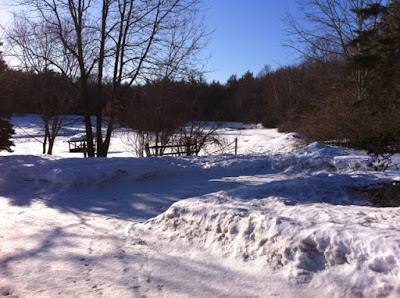
That thin piece of wood across the bottom is designed to be stapled on top of the plastic and hold the whole thing together as tightly as possible. Unfortunately, we didn’t have long enough staples, so I’m planning on finishing up the plastic and putting hinges on tomorrow morning. I’ll post more pictures of the completed cold frames then.In other news, the snow has finally melted enough that we can see what our future vegetable field will look like. I mentioned before that I was worried because I had been hearing more and more about how wet the field we were planning on using could get in the Spring. A visit to the NRCS (National Resources Conservation Service) field office in Westford at the beginning of March confirmed this fact (they have pretty detailed information on soil types and wetland areas throughout Massachusetts). Well everyone was right, the field is really wet. Right now we’re dealing with about this much visible water:Obviously, this puts a little snag in our plans to build a perfect 100′ x 200′ vegetable field (you may remember this picture from an earlier post:)While it’s a little disappointing that there’s a seasonal stream right through the middle of our perfectly rectangular 1/2 acre, this doesn’t mean we can’t grow at all. Our new plan is to put in two vegetable beds, one on each side of the wet area. We measured it out this last week, and we should be able to squeeze a 80′ x 90′ rectangle on the side closest to the house, and a 100′ x 50′ rectangle on the far side. We’re also planning on putting in a bridge across the stream at some point so that we can get machinery across (most importantly for tilling). This has been my first lesson in being flexible. I’m sure it won’t be my last. -
It’s March!
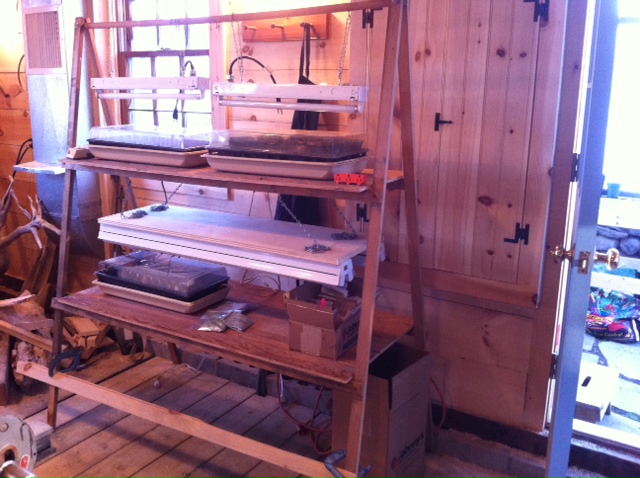
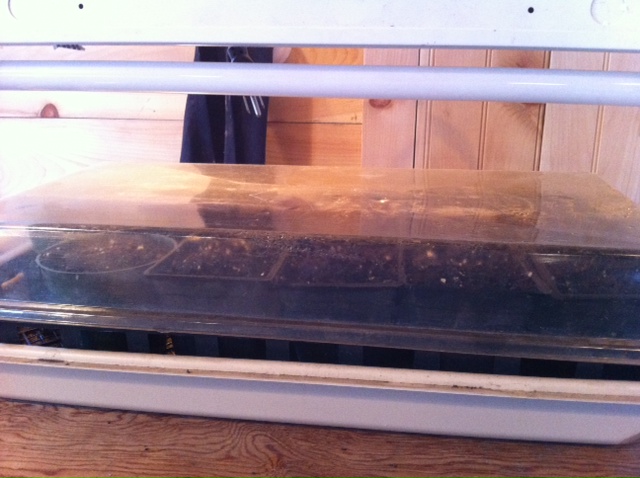
So, good news! Broody chicken rehab in the rabbit hutches worked! I released the two hens back into the coop last Monday morning and they’ve been acting pretty normal ever since. Here they are, acting pretty normal.More good news! We planted our first seeds of Spring today!! My mom and I set up a little grow light A‑frame in Dave’s wood shop, which is right next to the greenhouse.The seeds are all planted in six-cell flats or small plastic pots, and then placed in perforated trays for easy watering. They are also heated from underneath by heating trays and covered by plastic tops so they will stay warm even though it’s still cold around here.
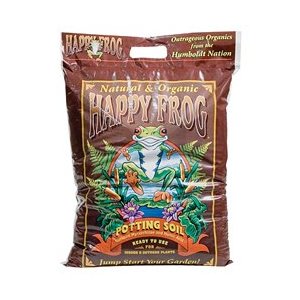
As you can see, there’s not very much going on yet, but it’s exciting! Today, we planted flowers (asters, calendula and sweet peas) as well as cilantro and parsley. These are the plants that require the most germination and indoor growing time before being transplanted outside. It’s still pretty early for us to be starting most seedlings, especially since we’re not sure when things are going to be able to go into the ground outside yet, but next week it’s going to be time to start the leeks and by the beginning of April things will really be getting going. And thanks to a lot of rain, the crusty, dirty snow piles are starting to recede, so it really does feel like Spring might actually be coming…Until then, however, here’s some more pictures of the greenhouse:The lettuce, swiss chard and kale is all doing great, and we’ve set up a little workstation with dirt (the mix we used today was half Happy Frog Potting Soil and half peat moss) and an area for planting. -
A (Kind-Of) Quick Update on Brooding Chickens
SO, I mentioned yesterday that I went down to the coop and noticed that one of the chickens was broody. A broody hen has decided to sit on her eggs with the purpose of hatching them. That would be great if we wanted chicks and had a bunch of fertile eggs to hatch, but in this case the hen was just intent on sitting on her nest no matter what. Broodiness can be a problem because often broody hens who have no chance of hatching any eggs will sit on their nests until they starve and dehydrate to death, and often it’s brought on by long days (I have a bad feeling that the heat lamp I put into the coop to keep them warm on freezing February nights might be to blame). We had been trying to remove her from the nest and take the eggs out from under her, but she was being stubborn, and a couple times I caught her sitting on nothing (and once an egg shaped piece of hard chicken poop). This morning I went down to the coop and found this:
It’s hard to tell what’s going on here, but there’s four chickens in that laying box. The first hen was still refusing to budge and another had joined her (broodiness can be contagious). Two other chickens were attempting to muscle their way in to lay some eggs and they were all getting pretty angry and pecking each other.
So I did a little research and found that sometimes it’s possible to dissuade a broody hen by simply blocking off the laying boxes and getting her away from the nest. So we put all the chickens outside and blocked off the boxes.
It didn’t work…an hour later they had managed to squeeze inside and there were four of them stuffed in behind the wood! Someone had laid an egg and someone else had broken it and now they were all eating it. Insanity.
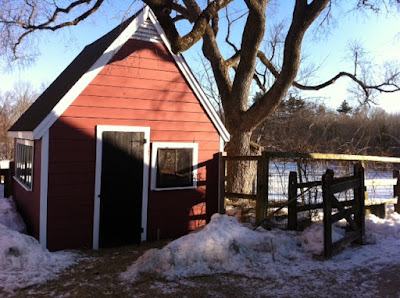
I tightened the gaps between the boards on the boxes, but the two hens just ended up settling down on the floor all puffed up and broody looking. A bunch of the sources I found online said that the best way to break broodiness is to remove the chickens entirely and put them somewhere totally unlike a nesting box. Ideally, this means a wire-bottomed cage off the floor with nowhere to bed down and a little cold air circulation underneath their bottoms (curing broodiness is all about cooling off the chicken’s bottom). I tried to brainstorm some options — the greenhouse, an empty horse stall, a dog crate — but none of them seemed right. Then I remembered the old empty rabbit hutches that are sitting in the barn.
And so I packed them up in a cat carrying case and brought them upstairs. The first broody hen is totally in blissed-out-dreaming-of-motherhood-mode (I can sympathize, I get the same way when I start thinking about my new birthday puppy, Angus, that I’m getting in March) and doesn’t even seem to care what I do with her. The second hen put up a little fight, but I’m stronger than a chicken.
There they are! I gave them some food and water and put down some hay on the floor in an attempt to control the mess. Here’s hoping their bums cool off soon! -
Planning for Vegetables and Pictures of Chickens
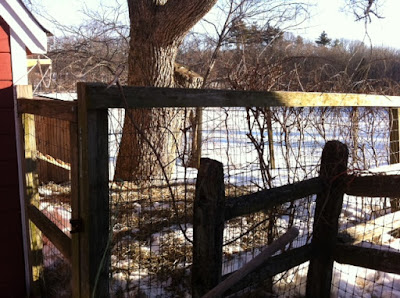
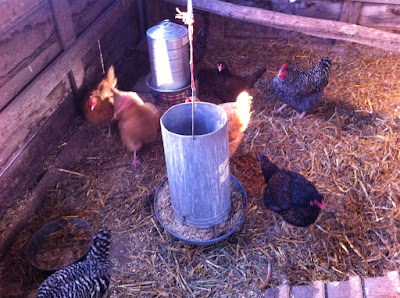
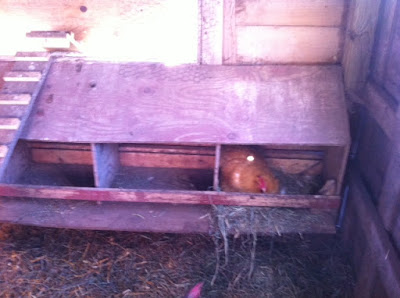
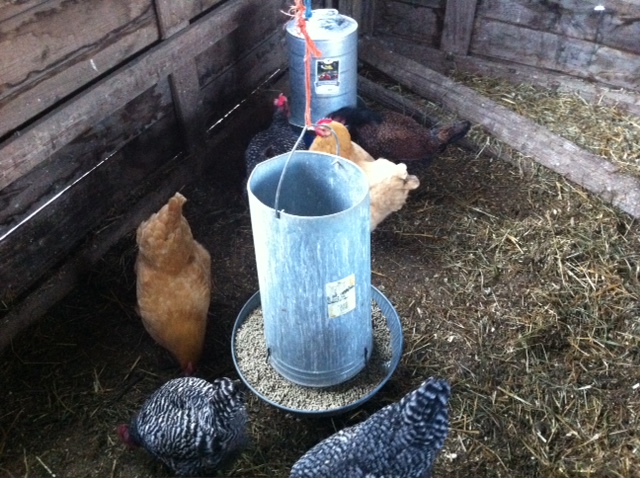
The seeds are arriving and slowly piling up in the corner of my room. Meanwhile, I’ve been trying to figure out what to do with them. In order to organize the information about each plant and get ready to make a full planting schedule I’ve been putting together spreadsheets. I have a page for each vegetable and then I list all the varieties separately. Then, using the Johnny’s catalog, the Cornell Cooperative Extension website and Coleman’s The New Organic Grower, as well as a couple of other sources, I’ve been compiling important growing information.First of all, I have to figure out what vegetables I’m going to start inside and then transplant, and what vegetables I’m going to seed directly into the garden. Some vegetable plants really have to be started inside, like the brassicas (cauliflower, broccoli, brussel sprouts and cabbage) and nightshades (tomatoes, eggplants, peppers). Luckily, the woman who owned Dave’s parents house before them had a cut flower business, and so she built a small greenhouse off the garage.The greenhouse, the windmill and the sun this morning The greenhouse really warms up during the day. Even in the middle of the winter I often have to open a window to stop the temperature inside from skyrocketing past 90 degrees F So far I’ve just been growing lettuce, kale, swiss chard and bak choy in the greenhouse. Dave built me some tables and boxes, about 6″ deep and of various sizes, and I was able to grow a fair amount of small, yet delicious, greens over the winter. This week however, I’m going to be pulling all the soil and the boxes out of there so we can start fresh with our new potting soil and transplants for the Spring.Next, I have to determine whether or not I’m going to be succession seeding the vegetables and, if so, how many times. For example, I’m growing 100′ (one row) of a variety of carrots called Scarlet Nantes. These carrots will grow from May 1st to July 15th, which is about 12 weeks. During those 12 weeks I’m going to want to be planting new seeds directly into the garden (carrots are difficult to transplant on account of their roots becoming irregular, plus they grow pretty quickly) every 3 weeks to ensure that I have a consistent supply of new growth. This means that I’m going to be doing at least 4 plantings, and so therefore each planting will involve seeding 25′ of the garden.This is all getting boring so I’ll just show an example.Each vegetable has it’s own sheet. After I’m done with the sheets I’m going to lay it all out on a MASTER calendar so I know exactly when I’m going to be planting everything, and how. Pretty exciting, right?Meanwhile, there are a lot of other things to think about. Right now, I’m worried because we keep hearing more and more about how wet the land we’re planning on planting on is. We haven’t really looked at it critically without the snow and so we’re not sure what to expect. The moisture could be an issue because we have to wait for the area to dry off in the Spring before we can even till the land, and with all the snow outside right now it doesn’t seem like it’s ever going to be dry. All this probably means that we’re going to get a late start this year, and are going to have to rely heavily on transplants.Right past those trees and under all that snow is the site of our future vegetable garden Alright, enough about the garden. Here’s some pictures of chickens!This is the chicken coop for layers Their yard. I put down some hay so they can come out and walk around on the snow which they seem to love until they get too cold And here they are! Laying boxes Right now we have 9 laying hens and we’re planning on bumping up the number to 30 this Spring, which is about as many as we can fit in this chicken coop while still making sure they all have enough space. That’s going to involve building a couple more laying boxes, although right now they all insist on using the box all the way to the right, and have kicked all the hay out of the other two.The hen in the laying box in this picture appears to have gone broody in the last couple of days, which means that she’s become intent on sitting on her eggs day in and day out, even if it means that she doesn’t eat or drink. This is also a problem because our delicious eggs are going bad underneath her. I’ve been reading about several ways to cure broodiness, everything from dipping their stomach in cold water (I don’t think that’s a good idea in the middle of Winter) to putting them in a cage by themselves up off the ground and away from the nest. I’ll report back later on how this problem progresses and how we manage to solve it. If anyone has any ideas, let me know.